
MONTHLY SPOTLIGHT
Why Demand Response Hasn’t Taken Off in India — And Why that Needs to Change
India’s electricity system is at an inflection point. Installed capacity has reached 520 GW, and for the first time, non-fossil sources account for more than half of it. Solar alone makes up nearly 27% of installed capacity, while wind constitutes ~10.5%.
However, generation tells a different story. Solar contributed only around 10% of actual electricity generated in January 2026; wind, just over 4%. The gap between what’s installed and what’s generated reflects a fundamental challenge: renewable energy is variable, seasonal, and hard to dispatch on demand.
Meanwhile, peak demand has already hit 250 GW and keeps climbing — driven by rising cooling needs, electric vehicles, and industrial growth.
These aspects together create a flexibility problem. As renewables grow, India is seeing midday surpluses and steep evening ramps. The system needs the ability to adjust — quickly and reliably — to keep supply and demand in balance.
Enter Demand Response
Flexibility can come from several places: the supply side (ramping power plants up and down), energy storage, improved grid operations, and from consumers adjusting how and when they use electricity.
In this last category — demand-side flexibility — is where Demand Response (DR) sits.
Demand-side flexibility refers to consumers’ ability to adjust electricity use to support system balance, while DR is the operational mechanism that activates this flexibility through price signals, incentives, or automated control. Note that DR constitutes discrete measures, while demand-side flexibility is a continuous endeavour.
The idea is straightforward. Instead of always adjusting supply to meet demand, you can also adjust demand to match supply. Pre-cool a building before the evening peak. Use smart thermostats to shave a few degrees off air conditioning loads during critical hours. Shift EV charging to midday when solar generation is abundant.
What makes DR especially attractive is speed and cost. New power plants and battery storage require large capital investments and long development timelines. DR, by contrast, can often be deployed rapidly through digital technologies and consumer participation — and many DR options are remarkably cost-effective.
Where India stands today
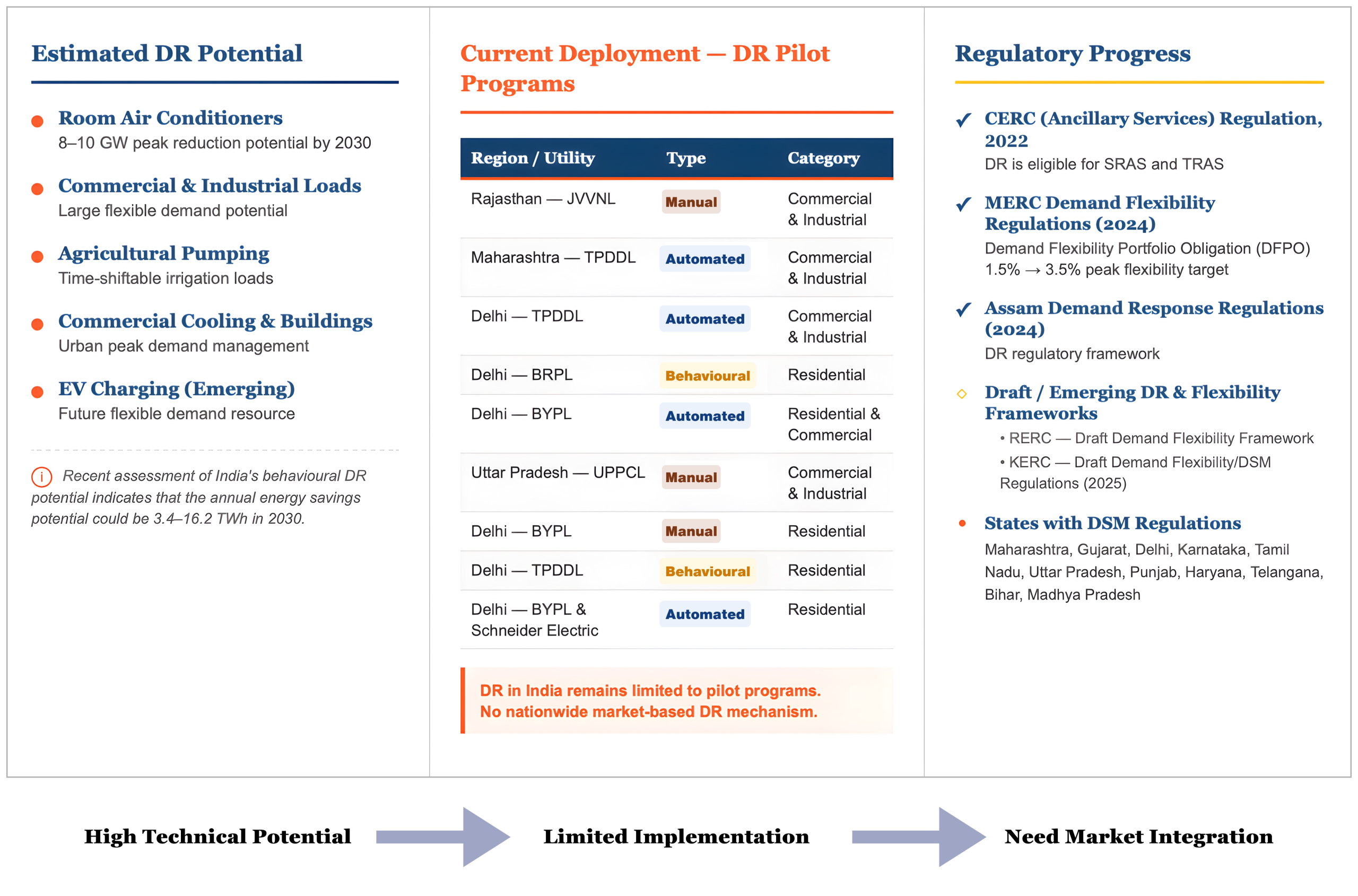
Studies suggest that behavioural DR could save 3.4–10.2 TWh [1] annually by 2030. DR-enabled air conditioners alone could shave 8–10 GW [2] off peak demand if about half of projected units participate. Several pilot programmes run by distribution companies have shown real value: avoided infrastructure investments, better peak management, and reduced procurement deviations.
On the regulatory front, DR is formally recognised as a grid flexibility resource under CERC’s Ancillary Services Regulations (2022) [3]. States are beginning to act too — Maharashtra has introduced a Demand Flexibility Portfolio Obligation[4], Assam has notified DR regulations[5]. Rajasthan Electricity Regulatory Commission has invited stakeholder comments on a draft demand flexibility framework[6]. Karnataka Electricity Regulatory Commission has released Draft Framework for Demand Flexibility/DSM Regulations (2025) [7]. Several other states have existing demand-side management regulations that could serve as a foundation.
And yet, despite all this activity, DR in India remains stuck at pilot scale. A nationwide, market-based DR mechanism does not exist.
Why Price Signals Alone are Not the Answer
The barriers are societal, technical, regulatory, and market-related — but the deepest challenge is conceptual. India has historically treated demand-side interventions as energy efficiency programmes: save electricity, reduce long-term consumption. DR has been framed through that same lens — encouraging consumers to save or cut peak usage — rather than as a dispatchable, measurable flexibility resource that grid operators can rely on.
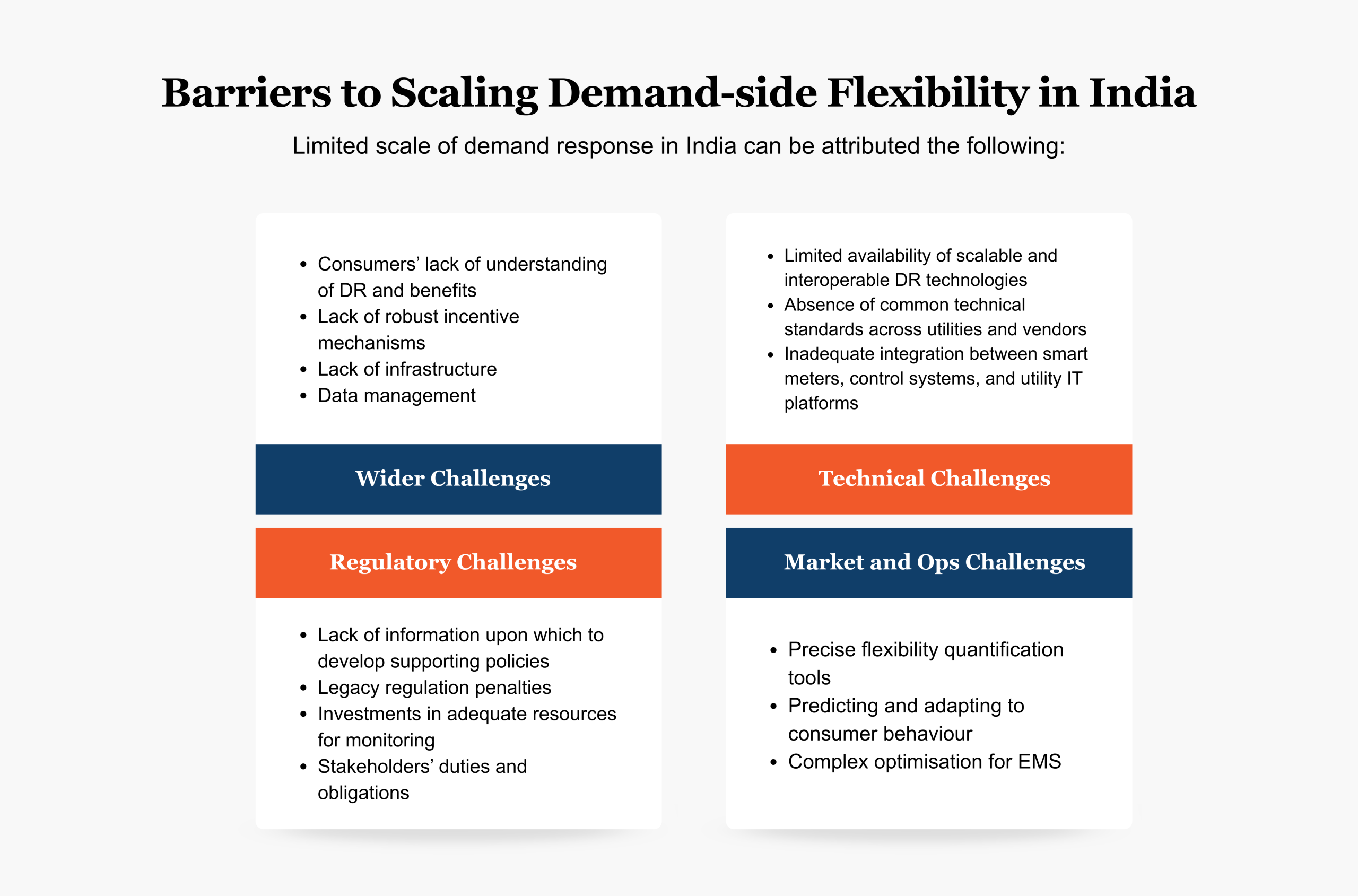
Price signals, like time-of-day tariffs, are often seen as the primary tool for activating DR. But on their own, they’re not enough. Voluntary consumer responses to price changes are insufficient for balancing real-time grid operations. Tariff differentials between peak and off-peak periods are often too small to change behaviour. And traditional tariff structures reward energy savings, not the flexibility services — peak capacity reduction, ramping capability, operating reserves — that grid operators actually need.
There are also structural gaps. India lacks distribution-level flexibility markets and demand aggregators that could bundle small loads — residential air conditioners, EV chargers, commercial cooling systems — into meaningful, dispatchable resources. Without these intermediaries and market platforms, individual consumers simply have no way to participate.
And there’s an ironic risk: poorly designed price signals can cause synchronised load-shifting, where everyone responds to low prices at the same time, creating new demand peaks instead of solving old ones.
——
In the upcoming pieces, we will explore case studies about tackling these challenges.
References:
[1] Sasidharan, C., Bhand, I., Rajah, V.B.., Ganti, V., Sachar, S., Kumar, S. “Whitepaper on roadmap for demand flexibility in India,” Alliance for an Energy Efficient Economy (AEEE), New Delhi, 2021.
[2] Awasthy S. and Thapa B., “Response-enabled room air conditioners: A call to action on scaling demand,” CLASP, 2025
[3] Central Electricity Regulatory Commission ancillary services regulations, 2022 [Online]. Available: https://www.cercind.gov.in/Regulations/Ancillary-Service-Regulations-2022.pdf
[4] Maharashtra electricity regulatory commission (Demand flexibility and demand side management – implementation framework, cost-effectiveness assessment; and evaluation, measurement and verification) Regulations, 2024 [Online]. Available: https://merc.gov.in/regulation_type/current-regulations-demand-side-management/
[5] Assam Electricity Regulatory Commission (Demand response), regulations 2024 [Online]. Available: https://aerc.gov.in/regulations/1722836861.pdf
[6] Draft Rajasthan Electricity Regulatory Commission [Demand Flexibility (DF)/Demand Side Management (DSM)] regulations, 2026 [Online]. Available: https://www.eqmagpro.com/wp-content/uploads/2026/02/DOC-1-12_compressed.pdf
[7] Draft Karnataka Electricity Regulatory Commission [Framework for Demand Flexibility (DF)/Demand Side Management (DSM)] regulations, 2025 [Online]. Available: https://kerc.karnataka.gov.in/uploads/media_to_upload1760767578.pdf