Resource Adequacy
Ensuring reliable electricity supply by planning the right mix of resources for every moment that matters.
What is Resource Adequacy?
Resource Adequacy (RA) refers to the ability of an electricity system to reliably meet consumer demand at all times, including during peak conditions and unexpected disruptions. It ensures that sufficient resources are available to maintain a secure and reliable power supply
Theoretical Handbook
Integrated
Resource Adequacy Assessment Framework
(I-RAA)
This theoretical handbook presents the Integrated Resource Adequacy Assessment (I-RAA) Framework, a comprehensive approach for evaluating RA in electricity systems undergoing rapid decarbonisation.
The I-RAA Framework moves beyond traditional capacity-centric planning by systematically integrating generation availability, fuel supply, transmission and distribution networks, demand-side resources, market design, and system resilience.
Designed to support reliable, secure, and climate-resilient power system planning, the handbook provides a structured set of concepts, metrics, and analytical guidance for policymakers, system planners, and energy professionals navigating the transition toward net-zero electricity systems.

Why This Handbook?
Evolving Power Systems
Rapid decarbonisation, growing electrification, and higher shares of renewable energy are reshaping electricity systems. These changes increase uncertainty and challenge traditional power system planning approaches.
Limitations of Traditional Adequacy Approaches
Conventional resource adequacy assessments focus mainly on capacity and peak demand, often overlooking fuel availability, network constraints, and operational realities in modern power systems.
Integrated Planning Framework
This handbook introduces an integrated framework that brings together generation, fuels, networks, demand-side resources, and markets to support reliable and resilient power system planning.
Part of a Three-Stage Exercise
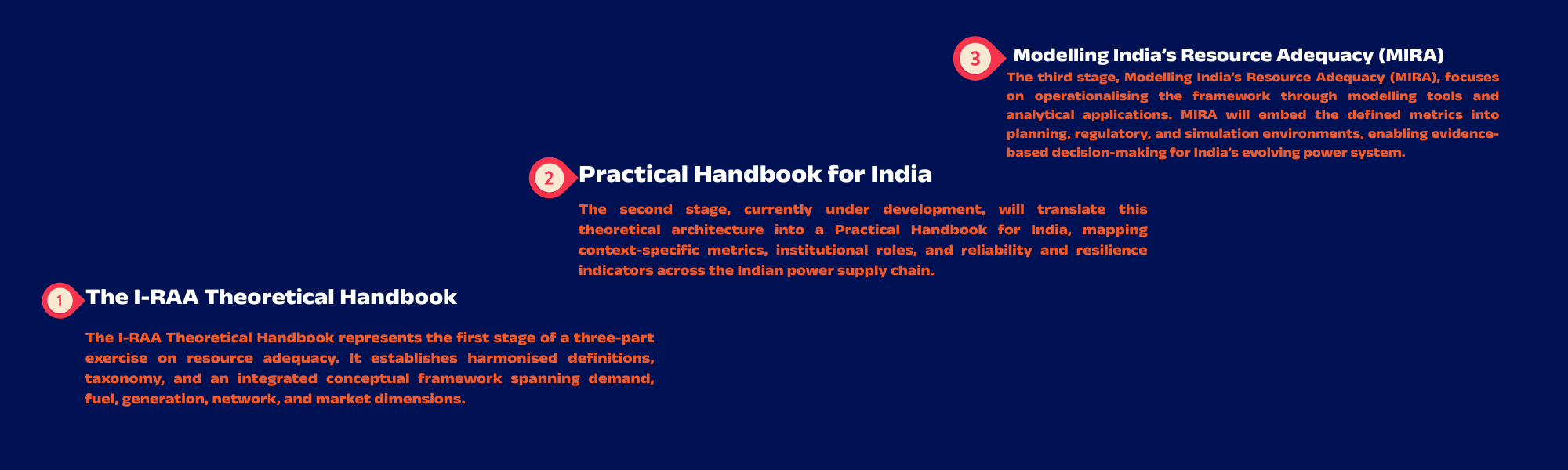
Together, these three stages move from theory, to contextual adaptation, to implementation.