
MONTHLY SPOTLIGHT
Scaling Demand Response: Global Lessons for India’s Power System Transformation
As discussed in the previous article, Demand Response (DR) in India remains largely limited to pilot programmes despite its significant potential. Existing approaches have primarily focused on peak shaving rather than enabling system flexibility; DR has not evolved into a dispatchable or market-integrated resource.
In contrast, several power systems globally have successfully integrated DR into electricity markets, which raises a critical question: How can India transition from pilot-based DR programmes to scalable, market-integrated demand-side flexibility?
Evolution of DR in Global Power Systems
The evolution of DR in power systems follows a well-established trajectory. Initially, DR emerged as part of Demand Side Management (DSM) programmes. Then, it evolved into utility-driven programmes aimed at reducing peak load. The most significant transition has been the evolution of DR into a market-integrated resource that participates alongside generation in electricity markets.
In systems such as PJM and California ISO in the USA, and the electricity market in the UK, DR is increasingly treated as a dispatchable and performance-accountable flexibility resource, with defined performance obligations and verification protocols. The shift is conceptual: DR is no longer voluntary load reduction, but a contracted system service.
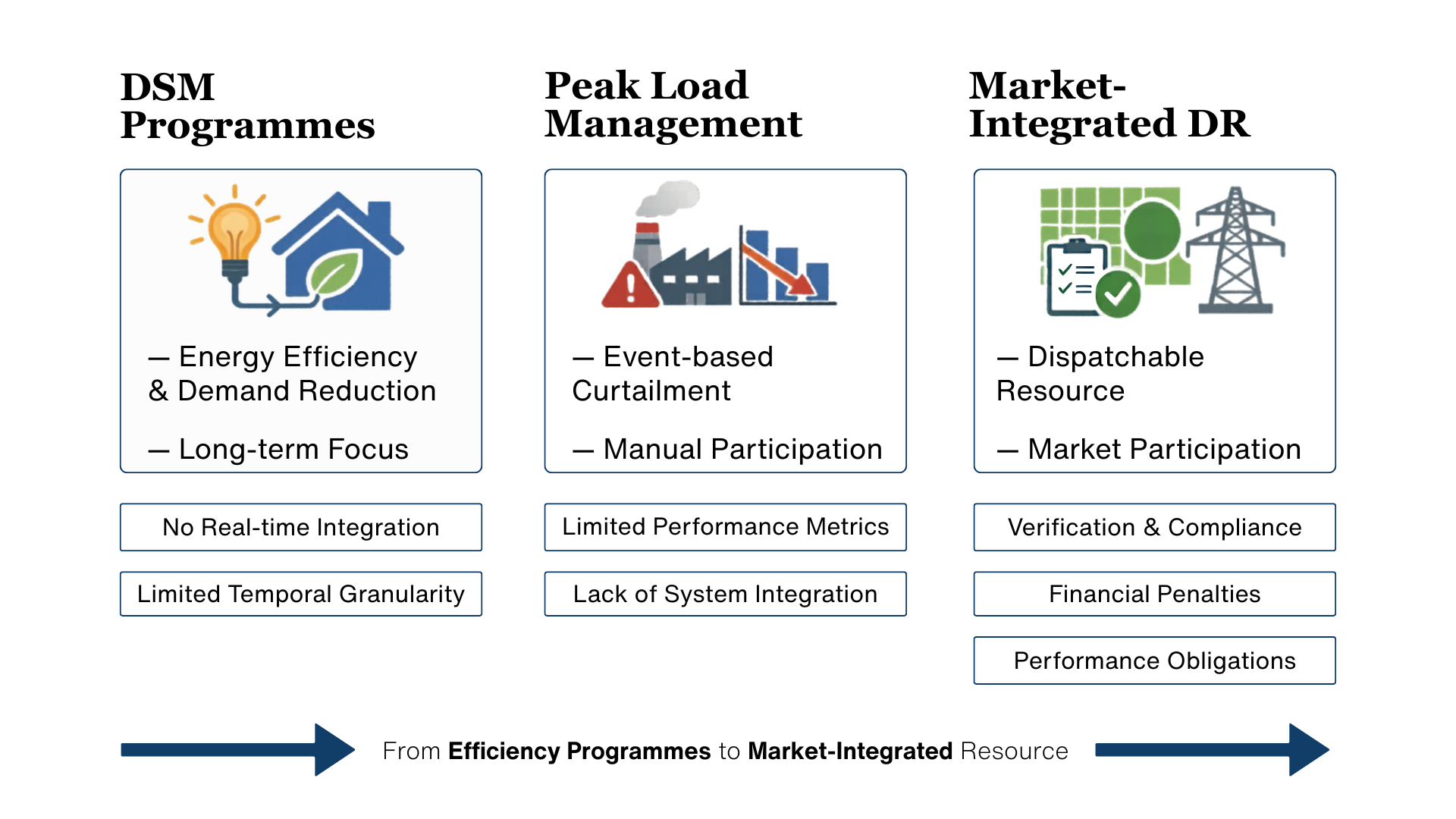
Figure 1: Evolution of Demand Response in Power Systems
How Demand Response Works in International Markets
DR has evolved differently across power systems depending on market design, regulatory maturity, and system needs. It is typically implemented across three main market segments: energy markets, capacity markets, and ancillary services markets. [1], [2], [3], [4]
In the United States, particularly in markets such as PJM, CAISO, and ERCOT, DR is highly developed and integrated across the aforementioned market segments. At the energy market level, DR can bid into day-ahead and real-time markets, effectively providing negawatts through demand reduction rather than electricity generation.
In PJM’s capacity market, DR provides firm resource adequacy, where aggregators commit load reductions during system-stress events and are compensated for availability.
In ancillary services, DR, often automated, provides reserves and frequency response. Recent reforms under FERC Order 2222 further enable aggregated distributed energy resources, including DR, to participate directly in wholesale markets. Operational experience also demonstrates its reliability, with system operators such as ERCOT deploying load resources during emergencies to rapidly reduce demand and maintain grid stability.
In the United Kingdom, DR resources participate in the Capacity Market, competing directly with generation to provide peak adequacy and system reliability. Also, the system operator (NESO) procures Demand Side Response for balancing services, including frequency response, reserve, and short-term operating reserve. [5], [6].
A key recent development is the demand flexibility service, which enables aggregated participation of households and businesses via suppliers and aggregators.
Participation has grown from 1.6 million (2022/23) to ~2 million (2024/25), with cumulative sign-ups exceeding 2.46 million by 2026, delivering over 3.6 GWh (2023/24) and ~3.9 GWh (2024/25) of demand reduction across events. [6], [7].
Demand flexibility service has evolved into a merit-based, year-round mechanism, procuring flexibility through priced offers.
A key upcoming reform is the Flexibility Market Asset Registration (FMAR) system [8] planned for 2027, which will act as a national registry of flexible assets.It will allow asset owners and aggregators to register through one system, reducing administrative burden and costs. By improving real-time, location-level visibility of distributed flexible assets, FMAR will support better coordination between transmission and distribution operators and enable more efficient procurement and dispatch of demand-side flexibility.
France was among the earliest European markets to enable DR participation, initially through industrial balancing mechanisms in 2003, and later through the NEBEF (Notification d’Échanges de Blocs d’Effacement) mechanism introduced in 2014. France’s model is particularly notable for enabling third-party aggregators, which significantly increases participation from distributed and small-scale consumers. Independent aggregators can directly participate in the energy market without requiring supplier consent.
In Australia, DR participation remains limited but is gradually emerging within both wholesale and ancillary service frameworks. Under the Wholesale Demand Response Mechanism, DR can participate in the wholesale energy market as dispatchable demand reduction. Uptake, however, has been modest — around 74 MW registered, less than 1% of peak demand, and limited dispatch volumes. [6]
In ancillary services, DR is technically eligible to participate in the Frequency Control Ancillary Services (FCAS) markets, which include regulation (continuous balancing) and contingency services. However, in practice, participation remains dominated by batteries and generation due to stringent performance and telemetry requirements.
In Japan, DR is primarily enabled through aggregator-led programmes. Aggregators coordinate distributed resources to provide services such as peak reduction and balancing support. Japan has also introduced capacity mechanisms where DR can participate. The focus is on integrating DR with distributed energy resources, forming virtual power plants that provide system-level flexibility.
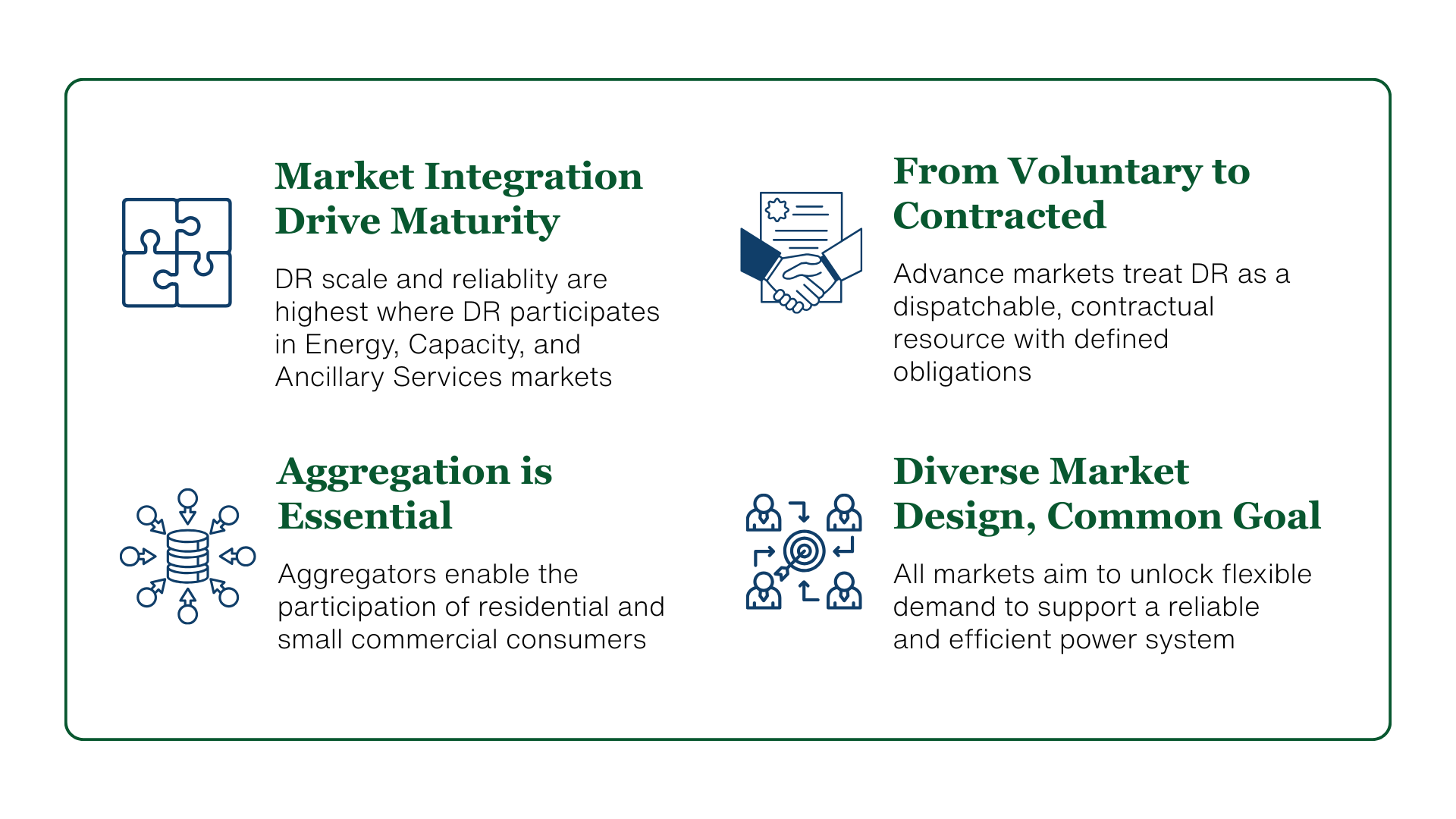
Figure 2: Key Cross-Country Insights
Key Enablers: Evidence from International Practice
India remains at an early stage of DR evolution, with efforts largely limited to pilots and DSM frameworks. International experiences highlight several enabling conditions for the successful integration of DR into power systems, presenting key country insights.
A. Foundational Enablers
- Measurement and Verification (M&V) frameworks are fundamental. The value depends on an accurate estimation of baseline consumption. Established markets employ statistically robust baseline methodologies, supported by high-frequency metering and transparent verification protocols. Without credible M&V, DR cannot evolve into a reliable and bankable system resource.
- Digital infrastructure and automation play a critical role in improving the reliability and scalability of DR. Technologies such as smart meters, automated DR systems, and advanced control platforms enable real-time response and reduce dependence on manual intervention. Empirical evidence indicates that automated DR programmes deliver more consistent and predictable performance compared to behavioural approaches.
- Standardised data exchange and interoperability enable scalability. Common communication protocols allow consumers, aggregators, and system operators data smoothly. These enablers make DR reliable, scalable, and capable of participating as a dispatchable resource in modern power systems.
B. Market Design and Operational Integration
- Demand response obligation requires utilities to procure demand-side flexibility, ensuring participation, improving reliability, and creating enforceable targets with incentives and penalties to scale DR deployment effectively.
- Dispatchability and performance accountability distinguish market-based DR from traditional programmes. DR resources in advanced markets are required to respond within defined timeframes, deliver measurable reductions, and comply with performance standards. Non-performance is subject to penalties, ensuring that DR behaves similarly to conventional generation resources in operational terms.
- Market integration is essential for unlocking the full value of DR. By allowing DR to participate in energy, capacity, and ancillary services markets, system operators can appropriately value its contribution to reliability and flexibility. This contrasts with traditional DSM frameworks, which primarily capture energy savings while neglecting capacity and flexibility benefits.
C. Regulatory and Policy Alignment
- Regulatory frameworks in advanced markets are designed to incentivise utilities and market participants to adopt DR by linking revenues to performance and system efficiency. In contrast, systems where revenues are tied to energy sales often face structural disincentives for demand reduction. Regulatory reforms, increased consumer awareness, and complementary policies, such as building codes, play important roles in accelerating adoption.
Way Forward for India
While international experience provides useful direction, India’s transition toward market-integrated DR will not be a single regulatory event but a sequenced reform. The first move is foundational: standardised measurement and verification protocols. Without credible baseline methodologies, DR cannot be reliably measured, contracted, settled, or integrated as a dispatchable system resource.
In parallel, a framework for aggregator participation needs to define who can aggregate, on what terms, and with what obligations to consumers, alongside the interoperable communication standards that let consumers, aggregators, DISCOMs, and system operators speak to each other.
Once these institutional and technical foundations are established, ancillary services markets could provide a practical entry point for operational DR integration due to their flexibility requirements, smaller response volumes, and measurable performance structures.
The larger question, though, is structural. DISCOM financial health; retail tariff structures that reward energy sales rather than system efficiency; and the absence of consumer-facing price signals are the conditions that determine whether any of this scales.
India does not need to invent the model. PJM, NEBEF, and the UK’s evolving flexibility architecture have done that work. What it needs is to decide that demand-side flexibility is a system resource worth building, and to align the regulatory incentives accordingly.
References
- “Assessment of Demand Response and Advanced Metering,”Federal Energy Regulatory Commission (FERC), 2023 [Online]. Available: https://www.ferc.gov/sites/default/files/2023-12/2023%20Assessment%20of%20Demand%20Response%20and%20Advanced%20Metering.pdf
- “Demand Response Operations Manual,”PJM Interconnection, 2023 [Online]. Available: https://www.pjm.com/-/media/DotCom/documents/manuals/archive/m38/m38v16-operations-planning-01-25-2023.pdf
- “Selecting and Implementing Demand Response Programs to Support Grid Flexibility,”The World Bank [Online]. Available: https://documents1.worldbank.org/curated/en/099647511282438850/pdf/IDU-0031c3e1-c08e-45e1-b50a-14842d7d19fd.pdf
- “Demand side flexibility – unleashing untapped potential for clean power,”ETC, 2025.
5.“Demand side response: A tool for lowering household energy bills,”UK Parliament Post, 2024 [Online]. Available: https://researchbriefings.files.parliament.uk/documents/POST-PN-0715/POST-PN-0715.pdf
6.“Electricity 2026: Analysis and forecast to 2030,”IEA, 2026 [Online]. Available: https://iea.blob.core.windows.net/assets/b73798cb-e452-42b9-9d8a-07542de7a041/Electricity_2026.pdf
7.“Demand Flexibility Service (DFS),”National Energy System Operator (NESO), 2025 [Online]. Available: https://www.neso.energy/document/363911/download
8.“Flexibility in the Energy Sector,”Centre on Regulation in Europe (CERRE), 2025 [Online]. Available: https://cerre.eu/wp-content/uploads/2025/05/CERRE-Report_Flexibility_Final.pdf